
Income-Driven Repayment (IDR) Professional Calculator
The Mother of All Student Loan Repayment Strategy Tools
Advanced simulation engine for public service and income-driven forgiveness. Factors in the 2026 HHS Poverty Guidelines, spouse income offsets, and the 'SAVE' interest subsidy to protect your net worth.










Income-Driven Repayment (IDR) Professional Calculator
Advanced simulation engine for public service and income-driven forgiveness. Factors in the 2026 HHS Poverty Guidelines, spouse income offsets, and the 'SAVE' interest subsidy to protect your net worth.
Loan Details
Income Profile
Plan Parameters
Household Configuration
National Statistics
Key data indicators relevant to the Income-Driven Repayment (IDR) Professional Calculator for National.
How to Use theIncome-Driven Repayment (IDR) Professional Calculator
A deep-dive tutorial on using our professional IDR simulator to maximize loan forgiveness and minimize monthly cash outflow.
About the Income-Driven Repayment (IDR) Professional Calculator
The Income-Driven Repayment (IDR) Professional Calculator represents the pinnacle of student debt strategy tools. Navigating the federal student loan landscape has shifted from simple banking to complex financial engineering. With the introduction of the SAVE (Saving on a Valuable Education) plan and the sunsetting of older programs, borrowers require a high-fidelity simulator that accounts for more than just monthly payments.
This "Mother of All" calculator is built on a 25-year simulation engine. It doesn't just look at today's income; it projects your financial trajectory over two decades, factoring in estimated income growth, household changes, and the ultimate tax liability of forgiven balances. By integrating the official 2026 Federal Poverty Guidelines for all 50 states (including special rates for Alaska and Hawaii), it provides precision that basic government tools often lack.
Whether you are a medical resident managing high six-figure debt, a public school teacher on the path to PSLF, or a recent undergraduate starting your first professional role, this tool provides the mathematical clarity needed to preserve your net worth. It handles the nuances of "Married Filing Jointly" vs. "Separately," including the critical spouse loan offset that can drastically reduce your monthly obligation.
Our mission is to ensure that no borrower is paralyzed by debt through lack of information. This calculator serves as your strategic navigator through the SAVE, PAYE, and IBR frameworks, ensuring you pay the absolute minimum required by law while maximizing every available federal subsidy and forgiveness benefit.
Features of the Income-Driven Repayment (IDR) Professional Calculator
SAVE Subsidy Engine
Automatically calculates the 100% interest waiver on the SAVE plan, ensuring your balance never grows from negative amortization.
25-Year Multi-Plan Simulation
Side-by-side comparison of SAVE, PAYE, and IBR trajectories over the full duration of the repayment term.
Tax Bomb Forecaster
Estimates the lump-sum tax liability at the end of the 20 or 25-year forgiveness period based on projected tax brackets.
Spousal Impact Logic
Calculates the exact weighted share of a joint IDR payment when both spouses have federal student loan balances.
Precise Geolocation Data
Integrates state-specific poverty guidelines for Alaska and Hawaii to ensure discretionary income calculations are 100% accurate.
Privacy-Locked Logic
Your sensitive income and debt data is processed entirely within your browser and never touches a server.
Weighted Grad/Undergrad Ratio
Applies the correct 5% to 10% SAVE calculation based on your specific mix of undergraduate and graduate loans.
Strategy Visualization
Interactive charts visualize the crossover points where aggressive payoff becomes better than strategic forgiveness.
How does the Calculator Work?
Calculation Process
Income vs. Poverty Analysis
We start by isolating your Discretionary Income. This is calculated by taking your Adjusted Gross Income (AGI) and subtracting a multiplier (150% or 225%) of the Federal Poverty Line based on your family size and state.
Weighted Percentage Application
The simulator applies the statutory rate for each plan. For SAVE, it weights the undergraduate (5%) and graduate (10%) portions. For PAYE and 'New' IBR, it applies a flat 10% to the discretionary amount.
Filing Status Optimization
If married, the tool analyzes whether your spouse's income and debt should be included. It models the impact of 'Married Filing Separately' to potentially lower your payment through legal income isolation.
25-Year Amortization Loop
Our engine runs a year-by-year simulation. It grows your income by your specified rate, adjusts the poverty line for inflation, and simulates exactly how much interest is subsidized vs. paid.
Forgiveness & Tax Settlement
At the end of the term (20 or 25 years), the calculator determines the remaining principal. It then applies your estimated future tax rate to project the 'Tax Bomb' cost of the forgiven amount.
Why should you use our Calculator?
| Feature | Our Calculator | Others |
|---|---|---|
| Projection Horizon | 25-Year Detailed Simulation | Single Year Estimate |
| Interest Subsidy | SAVE 100% Waiver Logic | Standard API Logic |
| Spousal Logic | Weighted Loan Share Ratio | Static Income Split |
| Tax Liability | Future Tax Bomb Forecast | Excluded |
| Data Privacy | Local-Only Processing | Server-Side Storage |
| Poverty Accuracy | AK/HI Geographic Tiers | Contiguous Only |
| Plan Depth | SAVE, PAYE, IBR (New/Old) | SAVE/PAYE Only |
| Income Growth | Custom Compound Rates | Static Income |
| Undergrad/Grad Mix | Proportional Rate Logic | Single Rate Assumption |
| Cost | 100% Free Professional Tool | Paid Financial Planner |
10 Scenarios: What is the Use of This Calculator Online?
Income-Driven Repayment (IDR) Professional Calculator Scenarios
| Scenario | Action Taken | Impact | Result |
|---|---|---|---|
| Public Service (Teacher) | Enroll in SAVE + PSLF | High | 100% Tax-Free Forgiveness |
| High Income spikes | Switch to Capped PAYE | Medium | Payments frozen at Std 10-yr |
| Newly Married (2 Loans) | Joint Filing Analysis | High | Shared Payment Efficiency |
| Graduate Degree Jump | 10% SAVE weighted rate | Medium | Higher monthly vs Undergrad |
| Family Size Increase | New Dependent Update | High | $50-100 Monthly Savings |
| Alaska Resident | Apply AK Poverty Line | Medium | Lower Discretionary Income |
| Interest-Only Payer | Switch to SAVE | Critical | Stopped Balance Growth |
| High Earner / Low Debt | Standard 10-Year Plan | Medium | Lower Total Lifetime Interest |
| Forgiveness Targeter | Set up Tax-Bomb HYSA | High | Future Liability Covered |
| Parent PLUS Borrower | Double Consolidation | Critical | Unlocks SAVE Eligibility |
Case Studies: Real World Success Stories
The Medical Resident Strategy
Situation
Dr. Chen had $280,000 in graduate loans earning $68,000 during residency.
Outcome
Calculator proved SAVE was superior to PAYE, saving $1,400 per month in interest growth.
The Married Filing Separately Pivot
Situation
Mark and Julia earned $150k combined, but Julia had $100k in debt while Mark had $0.
Outcome
Modeled filing separately to isolate Julia's $60k income for IDR.
The PSLF 'Tax-Free' Win
Situation
Sarah, a non-profit attorney, had $120k in debt and 4 years of service.
Outcome
Tool modeled the remaining 6 years of payments under SAVE.
The Undergraduate Early Start
Situation
Kevin started with $30k debt and $45k income. He wanted 'aggressive payoff'.
Outcome
The tool showed that SAVE's low payments + extra principal outperformed Standard 10-year.
The Large Family Protection
Situation
A family of 6 with $50k income was struggling with any payment.
Outcome
Calculator used 225% poverty line logic to show a $0 legal payment.
The Tax Bomb Survivor
Situation
Amit projected $80k in forgiveness in 20 years and feared the tax.
Outcome
Simulated a $75/mo investment into an index fund starting now.
Advantages and Risks
Advantages
- Drastic Reduction in Monthly Payments: Frees up cash flow for homes, kids, or retirement.
- 100% Interest Protection: The SAVE plan ensures your debt never gets larger than the day you started.
- Predictable Forgiveness: A guaranteed 'end-date' for your debt, regardless of the balance.
- Government Subsidies: Maximizes the use of the 225% poverty line protection for low-to-mid earners.
- Household Flexibility: Allows for legal strategic tax filing to minimize debt payments.
Disadvantages & Risks
- The 'Tax Bomb': Forgiveness in non-PSLF plans is currently taxable by the IRS.
- Mandatory Recertification: One missed paperwork deadline can capitalize your interest.
- Longer Debt Lifecycle: Taking 20-25 years to pay can result in higher total interest if not subsidized.
- Income Ceiling: Very high earners may find the Standard 10-year plan cheaper over time.
- Legislative Risk: IDR plans are subject to changes by Congress and the Department of Education.
Risks & Mitigation Strategies
Comprehensive Guide to Income-Driven Repayment (IDR) Professional Calculator
The Strategic Navigator's Guide to IDR
Federal student loans are unique in the financial world because they are the only major debt type where your payment is based on what you earn rather than what you owe. This creates a massive opportunity for strategic wealth building, provided you understand the mechanics of the "Discretionary Income" calculation.
The SAVE Plan Revolution
Historically, plans like REPAYE allowed interest to grow even if you made your required payment. The 2023 SAVE Plan changed the game by introducing a 100% interest subsidy. If your calculated payment is $50 but $300 of interest accrued this month, the government waives the remaining $250. This creates a "Hard Floor" on your debt—it can never grow.
Weighting Graduate vs. Undergraduate
A critical nuance often missed by basic calculators is the weighted payment rate. Starting July 2026, if you have only undergraduate loans, your SAVE payment is based on 5% of discretionary income. If you have any graduate loans, it scales linearly between 5% and 10%. Our calculator handles this calculus automatically, ensuring your projections are accurate.
The PSLF Advantage
For those in government or 501(c)(3) service, the 120-payment (10 year) track is the holy grail. It results in 100% forgiveness with no federal tax bomb. Always prioritize SAVE/PAYE for PSLF tracks.
The Tax Bomb Reality
If you aren't doing PSLF, the amount forgiven after 20-25 years is considered 'income' by the IRS. A $100k forgiveness could mean a $25k tax bill. We recommend early HYSA or brokerage funding to cover this.
Married Filing Separately (MFS) Optimization
For married couples, filing taxes separately is often a "secret weapon." While you may lose some tax credits (like the child tax credit or IRA deductions), the drop in student loan payments can often be $500 to $1,000 per month. You must perform a "Net Benefit" analysis, comparing the tax loss against the student loan gain.
Key Takeaways
- The SAVE plan offers a 100% interest subsidy, preventing balance growth regardless of payment size.
- Married borrowers can often save thousands by filing taxes separately to isolate their income from IDR calculations.
- Forgiveness reaching the 20-25 year mark triggers a 'Tax Bomb'—our tool estimates this future liability for proactive planning.
- Graduates with only undergraduate debt qualify for the 5% discretionary income rate on the SAVE plan.
- PSLF (Public Service Loan Forgiveness) is often the math-optimal route for non-profit and government employees.
- Consolidating Parent PLUS loans under specific rules can unlock standard IBR paths otherwise unavailable.
- Recertification of income is mandatory; missing the deadline results in capitalization of all accrued interest.
Frequently Asked Questions
Was this Income-Driven Repayment (IDR) Professional Calculator helpful?
Your feedback helps us improve our free tools.

Research & Development Support By: Vijayalaxmi Umachagi
CA, Legal, Financial Expert & Co-Founder
Vijayalaxmi Umachagi is a CA practitioner and financial expert by passion and an entrepreneur. She has 10+ years of Commerce, MCom and professional experience across finance and human resources who help developers build financial tools.

Built & Engineered By: Sachin Ramdurg
Software Engineer & Founder
Sachin Ramdurg is a software engineer by passion and an entrepreneur. He has 15+ years of engineering and professional experience across multiple domains, building accurate, high-performance financial tools and complex algorithms to make them accessible to everyone.
Community Insights
Real experiences and strategies from users of the Income-Driven Repayment (IDR) Professional Calculator.
Share Your Insight
David R.
"Used this to plan my budget for next year. The recommendations were actually helpful."
Sarah T.
"Fast, free, and accurate. Doesn't ask for my email either, which I love."
Alex
"I wish I found this tool sooner. The breakdown of {topic} is perfect."
Priya
"This {calc} was exactly what I needed. It helped me realize I could save thousands."
Sam
"I'm usually terrible at math, but this made calculating my {topic} super simple."
Deep Dive: Income-Driven Repayment (IDR) Professional Calculator Resources
Master your financial strategy with our expert-written, heavily researched guides.

What to Do Next?
Based on your analysis with the Income Based Repayment Calculator, these tools will help you execute the next phase of your financial plan.
Income-Based Repayment Calculator From iCreditCalculators

Income-Based Repayment Calculator From iCreditCalculators
Student loan payments can become difficult to manage when your income does not keep pace with your debt, especially early in a career. How to use an income-based repayment calculator becomes much easier once you understand the few numbers that drive the estimate: adjusted gross income (AGI), family size, loan balance, interest rate, and the applicable Income-Based Repayment (IBR) rules.
The iCreditCalculators Income-Based Repayment Calculator is designed to turn those inputs into a practical estimate so borrowers can understand potential monthly payments before making repayment decisions.
The need for this type of planning is significant. Federal Student Aid reported in September 2026 that about 42.3 million recipients had federal student loans totaling more than $1.7 trillion. The Direct Loan portfolio represented nearly 91% of that outstanding portfolio. For millions of borrowers, knowing how income affects repayment is not just a mathematical exercise; it can be an important part of household budgeting.
This guide explains what an Income-Based Repayment Calculator does, how IBR payments are calculated, which numbers matter, how the iCreditCalculators tool works, and how to interpret an estimate. Because federal student-loan rules have changed, the calculator should be viewed as a planning tool rather than a substitute for an official eligibility or payment determination from Federal Student Aid or your loan servicer.
About the Income-Based Repayment Calculator
The Income-Based Repayment Calculator from iCreditCalculators is a financial planning tool for borrowers who want to estimate student-loan payments using income-related repayment rules. The calculator uses information such as your loan balance, interest rate, adjusted gross income, family size, and state to produce an estimate. The iCreditCalculators tool also provides comparisons across income-driven repayment scenarios rather than requiring borrowers to perform each calculation manually.
This is useful because an income-driven payment is not determined simply by asking, “How much do I owe?” Your income and household circumstances can have a major effect on the calculation. Federal Student Aid explains that IDR payments are based on factors including income and family size, and borrowers generally must provide updated information each year so their payment can be recalculated. (Student Aid)
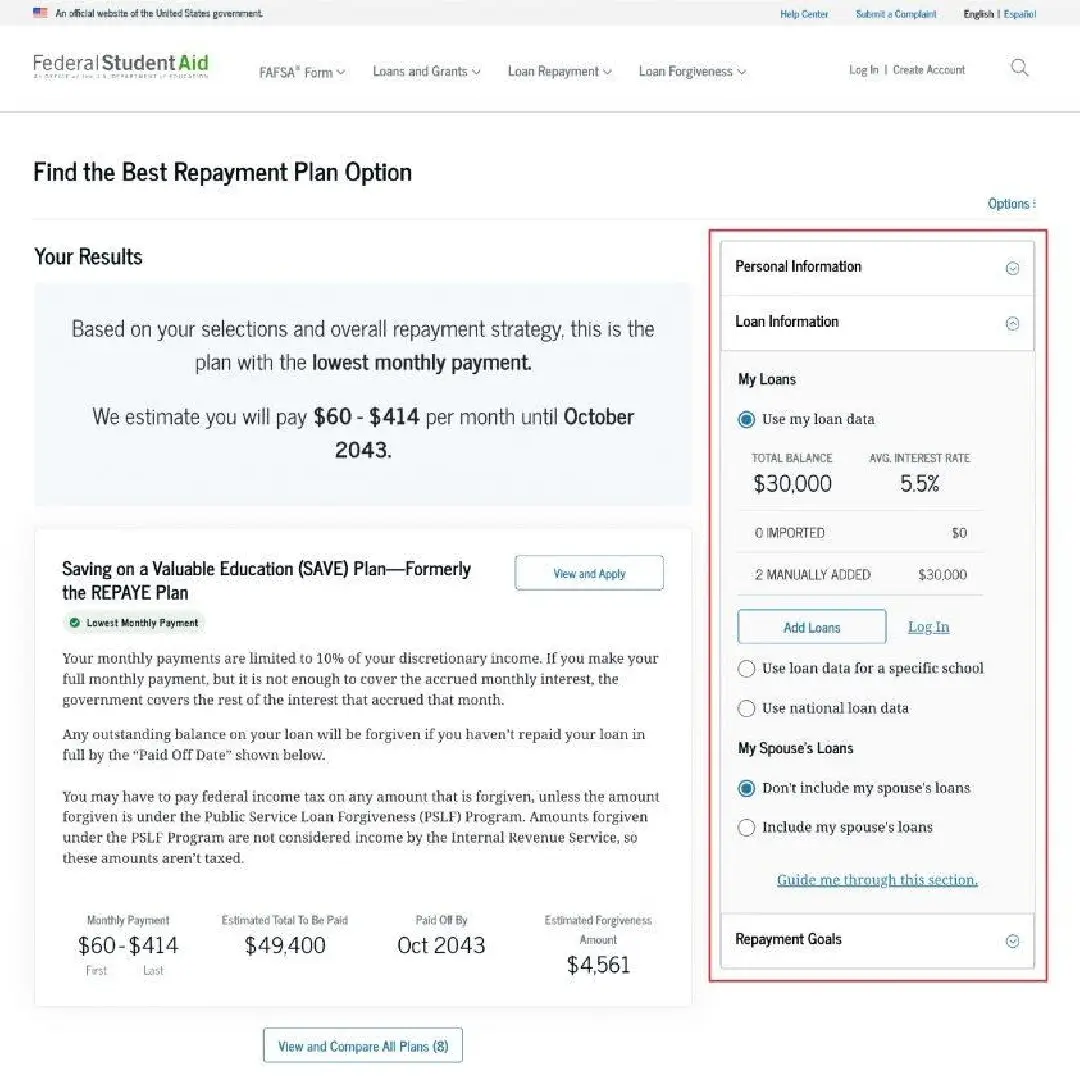
For example, consider two borrowers who each owe $50,000 in eligible federal student loans. If one borrower has an AGI of $40,000 and the other has an AGI of $90,000, their income-based payment calculations can be very different even though their loan balances are identical.
The calculator therefore helps answer a practical question:
“Based on my current financial information, what might my income-based student loan payment look like?”
That estimate can then be used as a starting point for budgeting, comparing repayment approaches, and understanding how changes in income or family size could affect future payments.
What Is an Income-Based Repayment Calculator?
An Income-Based Repayment Calculator is an online calculator that estimates a borrower's potential monthly student-loan payment under the Income-Based Repayment framework.
IBR is one type of income-driven repayment plan for eligible federal student loans. Unlike a traditional fixed repayment calculation, an income-driven calculation considers the borrower's income and family circumstances. Federal Student Aid's current information states that borrowers with eligible loans taken out before July 1, 2026 can access IBR, subject to the applicable eligibility rules. (Student Aid)
The current federal rules also distinguish between new borrowers and other IBR borrowers. Federal Student Aid currently lists IBR at 15% of discretionary income for borrowers who are not considered new borrowers and 10% for new borrowers, with a maximum payment generally limited to what the borrower would pay under the 10-year Standard Repayment Plan. The repayment period is generally 25 years, or 20 years for new borrowers, subject to the applicable federal rules. (Student Aid)
This distinction is important when using a calculator. You should not assume that every borrower receives the same percentage.
Why Income Matters
The basic idea behind IBR is that payment capacity is connected to income rather than being determined solely by the outstanding loan balance.
A borrower earning $35,000 a year and another earning $100,000 a year could have the same student-loan balance, but their income-based payments may be very different.
Family size also matters because the federal calculation uses poverty-guideline amounts to determine the portion of income that is protected before discretionary income is calculated.
For 2026, the HHS poverty guideline for a one-person household in the 48 contiguous states and Washington, D.C., is $15,960. For a four-person household, it is $33,000. Alaska and Hawaii have separate guidelines. (ASPE)
That means a calculator needs more information than simply your salary.
Formula to Calculate an Income-Based Repayment Payment
The central calculation begins with discretionary income.
For the traditional IBR framework reflected in current Federal Student Aid information, discretionary income is generally based on the difference between your adjusted gross income and 150% of the applicable federal poverty guidelines for your family size and location.
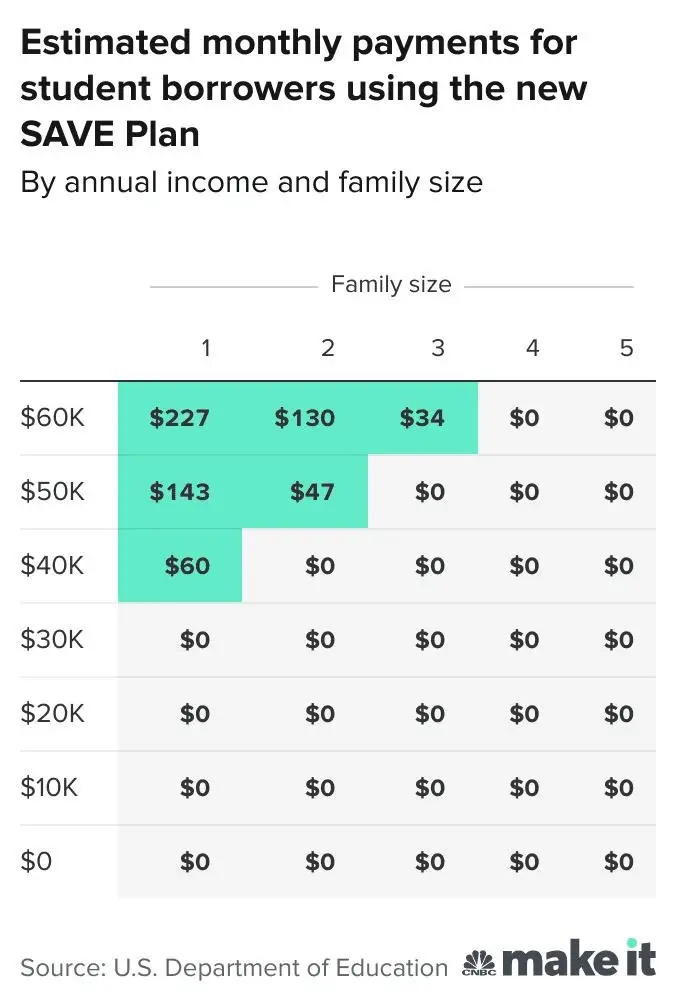
Step 1: Calculate Discretionary Income
Discretionary Income = AGI − (150% × Federal Poverty Guideline)
Where:
| Abbreviation | Meaning |
|---|---|
| AGI | Adjusted Gross Income |
| 150% | The applicable percentage of the federal poverty guideline used in the traditional IBR calculation |
| Federal Poverty Guideline | HHS poverty guideline applicable to your household size and location |
If the resulting discretionary income is positive, the applicable IBR percentage can then be applied.
Step 2: Calculate Annual IBR Payment
For a borrower subject to the 15% IBR rate:
Annual IBR Payment = Discretionary Income × 15%
For a qualifying new borrower subject to the 10% rate:
Annual IBR Payment = Discretionary Income × 10%
Step 3: Calculate Monthly IBR Payment
Monthly IBR Payment = Annual IBR Payment ÷ 12
The applicable payment also cannot generally exceed the amount the borrower would pay under the 10-year Standard Repayment Plan. (Student Aid)
Simple Formula Summary
| Calculation | Formula |
|---|---|
| Protected income | 150% × Federal Poverty Guideline |
| Discretionary income | AGI − Protected Income |
| Annual IBR payment | Discretionary Income × Applicable IBR Rate |
| Monthly IBR payment | Annual IBR Payment ÷ 12 |
| Applicable IBR rate | 15% or 10%, depending on borrower status |
Important: These formulas are useful for understanding the calculation, but an estimate from a calculator should not be treated as an official federal payment determination. Federal student-loan eligibility and payment rules can depend on loan type, disbursement dates, borrower history, family circumstances, tax information, and other factors.
2026 Poverty Guidelines and Why They Matter
The federal poverty guideline is an important input in an income-driven repayment calculation because it determines how much income is protected before discretionary income is calculated.
For 2026, the HHS guidelines for the 48 contiguous states and the District of Columbia are:
| Family Size | 2026 Poverty Guideline | 150% of Guideline |
|---|---|---|
| 1 | $15,960 | $23,940 |
| 2 | $21,640 | $32,460 |
| 3 | $27,320 | $40,980 |
| 4 | $33,000 | $49,500 |
| 5 | $38,680 | $58,020 |
| 6 | $44,360 | $66,540 |
| 7 | $50,040 | $75,060 |
| 8 | $55,720 | $83,580 |
The HHS figures show that households in Alaska and Hawaii use different poverty guidelines. For example, the 2026 guideline for a one-person household is $19,950 in Alaska and $18,360 in Hawaii, compared with $15,960 in the 48 contiguous states and D.C. (ASPE)
This geographic difference matters because using the wrong poverty guideline can produce a different discretionary-income estimate.
Example of the Poverty-Guideline Calculation
Suppose a borrower:
- Has an AGI of $60,000
- Has a family size of 2
- Lives in one of the 48 contiguous states
- Uses the traditional 150%-of-poverty-guideline calculation
The 2026 poverty guideline for a two-person household is $21,640. (ASPE)
Therefore:
150% × $21,640 = $32,460
Then:
$60,000 − $32,460 = $27,540
The borrower's estimated discretionary income would therefore be $27,540 per year before applying the applicable IBR percentage.
If the borrower falls under the 10% IBR rate:
$27,540 × 10% = $2,754 per year
Then:
$2,754 ÷ 12 = $229.50 per month
This is a simplified illustration of the formula. The actual federal determination can involve additional eligibility and payment rules.
How to Use the Income-Based Repayment Calculator
Using the calculator is straightforward because you only need to provide several key financial details.
Step-by-Step Instructions
Step 1: Enter your loan balance
Enter the current outstanding balance of the federal student loans you want to analyze.
For example:
Loan Balance = $60,000
Use your current balance rather than the amount you originally borrowed. If you have several eligible loans, make sure you understand whether you are entering the combined balance or analyzing a particular loan group.
Step 2: Enter your interest rate
Enter the applicable average interest rate for the loans being analyzed.
For example:
Interest Rate = 6.50%
The interest rate is especially important when you are looking beyond the estimated monthly payment because interest affects how quickly your balance declines.
Step 3: Enter your adjusted gross income
Enter your Adjusted Gross Income (AGI) rather than simply entering your gross salary unless the calculator specifically asks for another income figure.
For example:
AGI = $60,000
Your AGI can differ from your salary because tax deductions and other adjustments can affect the amount reported as adjusted gross income.
Step 4: Enter your family size
Enter the number of people included in your applicable family size.
For example:
Family Size = 2
This information matters because the applicable federal poverty guideline changes with household size.
Step 5: Select your state
Choose your state of residence.
This is particularly important for borrowers in Alaska and Hawaii, because HHS publishes separate poverty guidelines for those states. (ASPE)
Step 6: Select or review the applicable repayment plan
If the calculator provides multiple repayment-plan options, select IBR when you specifically want to examine Income-Based Repayment.
The iCreditCalculators calculator is designed to compare income-driven repayment scenarios, while its more advanced IDR calculator also incorporates additional inputs and longer-term simulations.
Step 7: Calculate the estimate
Select the calculator's calculation option.
The calculator processes the information and provides an estimated repayment result.
Step 8: Review the result
Do not look only at the monthly payment.
Also consider:
- Estimated annual payment
- Loan balance
- Interest rate
- Potential repayment period
- Potential remaining balance
- Possible forgiveness implications
- How income changes could affect future payments
This broader view is important because the lowest estimated monthly payment is not automatically the same thing as the lowest overall borrowing cost.
How the Calculator Works Behind the Scenes
The calculation can be understood as a sequence rather than one complicated equation.
First, the calculator identifies your income input. It then uses family size and applicable poverty-guideline information to determine the protected income amount.
Next, it estimates discretionary income.
After that, the applicable IBR percentage is applied to the discretionary income. The annual amount is divided by 12 to produce an estimated monthly payment.
Finally, the result needs to be considered against applicable federal payment limits and eligibility rules.
This approach is much easier to understand when viewed as a simple flow:
AGI → Poverty Protection → Discretionary Income → IBR Percentage → Annual Payment → Monthly Payment
The iCreditCalculators calculator is intended to simplify this process so borrowers do not have to repeatedly calculate each stage manually. Its published calculator information says that it uses loan balance, interest rate, AGI, family size, and state information for its income-driven repayment estimates.
Why the Calculator Uses More Than Your Salary
A common mistake is assuming:
“My salary is $60,000, so my payment must be a fixed percentage of $60,000.”
That is not how the traditional IBR discretionary-income calculation works.
Instead, the calculation first considers the applicable poverty-guideline protection.
For example, using the two-person 2026 guideline:
$60,000 − $32,460 = $27,540
The percentage is applied to the resulting discretionary income, not simply to the full $60,000.
That difference can be substantial.
What Makes an Income-Based Repayment Calculator Useful?
The biggest advantage is that it turns an unfamiliar federal repayment formula into a number that can be used for budgeting.
A borrower can test different scenarios, such as:
- Higher income
- Lower income
- Different family size
- Different loan balances
- Different interest rates
- Different states
This makes the calculator useful not only when selecting a repayment strategy, but also when planning for future changes.
For instance, someone earning $50,000 today may expect to earn $70,000 after several years. Running both scenarios can show how a higher income could affect an income-based payment.
Similarly, a borrower whose household grows can test a different family size and see how the applicable poverty-guideline amount changes.
Federal Student Aid confirms that borrowers enrolled in income-driven plans must generally provide updated income and family-size information each year so their payment can be recalculated. (Student Aid)
That is why an IBR calculator can be useful repeatedly rather than only once.
Important 2026 Federal Rule Changes to Keep in Mind
The federal student-loan repayment system has changed significantly, so older articles and calculators can contain information that no longer reflects current rules.
Federal Student Aid states that the One Big Beautiful Bill Act made significant changes to federal student-aid programs. Its current repayment-plan information says that borrowers with eligible loans taken out before July 1, 2026 may access IBR, ICR, and PAYE, subject to the rules described by Federal Student Aid. It also states that receiving a first disbursement on a new loan on or after July 1, 2026 can affect eligibility for those plans. (Student Aid)
This is one reason a calculator estimate should always be checked against current official federal guidance.
The current Federal Student Aid information also identifies Repayment Assistance Plan (RAP) as part of the changed IDR landscape for eligible newer loans. (Student Aid)
Therefore, when comparing an IBR estimate with another repayment option, borrowers should use the rules applicable to their specific loans and circumstances, rather than assuming that a plan available to an older borrower will automatically be available for a newer loan.
Federal Student Aid remains the appropriate source for an official determination. You can review the current federal repayment-plan information at Federal Student Aid – Repayment Plans.
Features of the Income-Based Repayment Calculator
The iCreditCalculators Income-Based Repayment Calculator is useful because it brings several parts of an income-driven repayment calculation into one place. Instead of manually looking up a poverty guideline, calculating discretionary income, applying a repayment percentage, and dividing the result by 12, a borrower can enter the relevant information and review an estimate.
The calculator is particularly useful for scenario planning. A borrower can change income, family size, loan balance, or other inputs and see how the estimated result changes. That makes it easier to understand that an income-driven payment is not a permanent number. Federal Student Aid states that IDR payments are generally recalculated each year using updated income and family-size information. (Student Aid)
Key Calculator Features
Some of the most useful features include:
- Income-based payment estimation
- Loan balance analysis
- Interest-rate consideration
- Family-size consideration
- State-specific information
- Discretionary-income calculation
- Monthly payment estimation
- Scenario comparison
- Long-term repayment planning
- Easy-to-understand results
The value of these features becomes clearer when you consider how many borrowers are dealing with student debt. As of June 30, 2026, the federal student-loan portfolio included 42.3 million recipients and more than $1.7 trillion in federal student loans, according to the latest Federal Student Aid Data Center update. (FSA Partner Connect)
That makes repayment planning relevant to a very large group of U.S. borrowers.
Why Use the iCreditCalculators Calculator?
One of the main reasons to use an online calculator is simplicity.
The underlying federal formula can appear complicated when you first encounter terms such as AGI, discretionary income, poverty guidelines, repayment percentages, and repayment periods. A calculator organizes those inputs into a single process.
For example, suppose you want to test what happens if your income increases from $50,000 to $65,000. You can run the calculation under both income levels instead of trying to estimate the change mentally.
This is useful when preparing a household budget, considering a career change, planning for marriage, or evaluating whether a future salary increase could affect your student-loan payment.
The calculator can also help you identify an important difference between monthly affordability and total repayment cost. A lower monthly payment can provide more room in a monthly budget, but taking longer to repay a debt can mean that interest continues to accrue for a longer period.
Why Our Calculator Can Be Useful Compared With Manual Calculations
Manual calculations are possible, but they create several opportunities for mistakes.
A borrower might:
- Use the wrong poverty guideline.
- Forget to account for family size.
- Apply the wrong IBR percentage.
- Divide or multiply incorrectly.
- Use an outdated federal rule.
- Confuse AGI with gross salary.
- Forget that eligibility depends on the type and timing of the federal loan.
A calculator reduces the amount of arithmetic the borrower has to perform.
However, there is an important distinction between calculation convenience and official eligibility determination. An online calculator can estimate a payment based on the information entered, but Federal Student Aid and your loan servicer determine your actual repayment-plan eligibility and payment under the federal rules applicable to your loans.
That distinction is especially important in 2026 because federal repayment rules have changed. Federal Student Aid currently says that eligible loans taken out before July 1, 2026 may have access to IBR, while receiving a first disbursement on a new loan on or after July 1, 2026 can affect eligibility for IBR and other older IDR plans. (Student Aid)
Who Should Use an Income-Based Repayment Calculator?
The calculator can be useful for several groups of borrowers.
1. Borrowers With High Student Debt Relative to Income
IBR is designed for borrowers whose federal student-loan debt is high compared with their income. Federal Student Aid currently describes IBR payments as 15% of discretionary income, or 10% for new borrowers, subject to the applicable rules and payment limits. (Student Aid)
Someone with substantial student debt and a relatively modest income may therefore want to understand whether an income-driven calculation could produce a more manageable payment.
2. Recent Graduates
A recent graduate may have a relatively low starting income but expect that income to grow.
Running an estimate at the current income can establish a starting point. The borrower can then run additional scenarios at higher incomes to understand how payment amounts could change.
3. Borrowers Changing Careers
A career change can produce a temporary drop or increase in income.
For example, a borrower earning $90,000 in one occupation may move into a profession paying $55,000 during the first few years. An income-based repayment calculation can help the borrower understand how that lower income could affect the estimated payment.
4. Families
Family size matters because the poverty-guideline calculation changes as household size changes.
A borrower with one dependent and a borrower with three dependents should not automatically expect the same discretionary-income calculation when their AGIs are identical.
5. Borrowers Preparing for Annual Recertification
Income-driven repayment is not a “set it and forget it” arrangement.
Federal Student Aid says borrowers must generally recertify their income and family size once a year. It also says that borrowers can view their recertification date through their StudentAid.gov account. (Student Aid)
Using a calculator before recertification can help a borrower estimate what a changed income or family size could mean for the next payment period.
Ten Income-Based Repayment Examples
The following examples are illustrations of the calculation mechanics, not official payment quotes. They use simplified assumptions so the effect of income and family size can be seen clearly.
For these examples, assume the traditional IBR discretionary-income formula:
Discretionary Income = AGI − 150% of the Applicable Poverty Guideline
Then:
Monthly IBR Payment = (Discretionary Income × Applicable IBR Percentage) ÷ 12
Actual eligibility, applicable repayment percentage, loan type, payment cap, and federal rules must be checked for the individual borrower.
Example 1: Single Borrower With $40,000 AGI
Suppose:
- AGI = $40,000
- Family size = 1
- 2026 poverty guideline = $15,960
- 150% poverty guideline = $23,940
- Applicable IBR rate = 10%
First:
$40,000 − $23,940 = $16,060
The estimated discretionary income is $16,060.
Annual payment:
$16,060 × 10% = $1,606
Monthly payment:
$1,606 ÷ 12 = $133.83
So the simplified estimated payment is approximately $133.83 per month.
This example shows why the entire AGI is not necessarily subjected directly to the IBR percentage. The protected income amount is deducted first.
Example 2: Single Borrower With $60,000 AGI
Now assume:
- AGI = $60,000
- Family size = 1
- 150% poverty guideline = $23,940
- IBR rate = 10%
Discretionary income:
$60,000 − $23,940 = $36,060
Annual payment:
$36,060 × 10% = $3,606
Monthly payment:
$3,606 ÷ 12 = $300.50
The simplified estimate is therefore $300.50 per month.
Compared with Example 1, the borrower earns $20,000 more, but the calculated payment does not increase by 10% of the entire $20,000. The protected portion of income remains part of the calculation.
Example 3: Family Size of Two
Consider:
- AGI = $60,000
- Family size = 2
- 2026 poverty guideline = $21,640
- 150% poverty guideline = $32,460
- IBR rate = 10%
Discretionary income:
$60,000 − $32,460 = $27,540
Annual payment:
$27,540 × 10% = $2,754
Monthly payment:
$2,754 ÷ 12 = $229.50
The simplified estimated payment is $229.50 per month.
Compare that with Example 2, where the same $60,000 AGI and a family size of one produced $300.50. The difference comes from the larger poverty-guideline protection associated with the larger family size.
Example 4: Family Size of Four
Suppose:
- AGI = $75,000
- Family size = 4
- 2026 poverty guideline = $33,000
- 150% poverty guideline = $49,500
- IBR rate = 10%
Discretionary income:
$75,000 − $49,500 = $25,500
Annual payment:
$25,500 × 10% = $2,550
Monthly payment:
$2,550 ÷ 12 = $212.50
The simplified monthly result is $212.50.
This example demonstrates why family size should not be ignored when estimating an income-driven payment.
Example 5: Higher Income at the Same Family Size
Assume:
- AGI = $100,000
- Family size = 4
- 150% poverty guideline = $49,500
- IBR rate = 10%
Discretionary income:
$100,000 − $49,500 = $50,500
Annual payment:
$50,500 × 10% = $5,050
Monthly payment:
$5,050 ÷ 12 = $420.83
The simplified result is $420.83 per month.
The borrower in Example 4 had an AGI of $75,000 and an estimated payment of $212.50. Increasing AGI to $100,000 raises the simplified estimate to $420.83.
This illustrates one of the central characteristics of income-driven repayment: changes in income can change the payment.
Example 6: Borrower Subject to the 15% Rate
Now consider a borrower who falls under the IBR rules using the 15% discretionary-income rate.
Suppose:
- AGI = $70,000
- Family size = 2
- 150% poverty guideline = $32,460
- Applicable IBR rate = 15%
Discretionary income:
$70,000 − $32,460 = $37,540
Annual payment:
$37,540 × 15% = $5,631
Monthly payment:
$5,631 ÷ 12 = $469.25
The simplified estimated payment is $469.25 per month.
This example demonstrates why identifying the applicable borrower category matters. Federal Student Aid currently states that IBR uses 15% for borrowers who are not new borrowers and 10% for new borrowers, subject to the applicable rules. (Student Aid)
Example 7: Lower Income With a Larger Family
Suppose:
- AGI = $45,000
- Family size = 4
- 150% poverty guideline = $49,500
- IBR rate = 10%
The simplified calculation gives:
$45,000 − $49,500=-$4,500
Because the resulting discretionary income is not positive, a simple percentage calculation would not produce a positive income-based payment from this formula.
This is an important example because it shows why you should not simply calculate 10% of income.
The actual federal payment determination must still be made under the applicable rules for the borrower's loans and circumstances.
Example 8: High Income and Large Household
Suppose:
- AGI = $120,000
- Family size = 4
- 150% poverty guideline = $49,500
- IBR rate = 10%
Discretionary income:
$120,000 − $49,500 = $70,500
Annual payment:
$70,500 × 10% = $7,050
Monthly payment:
$7,050 ÷ 12 = $587.50
The simplified estimate is $587.50 per month.
The calculation demonstrates that having a larger family does not necessarily result in a low payment. Income remains an important part of the equation.
Example 9: Same Income, Different Family Sizes
Consider two borrowers, both earning $80,000 and both using a 10% simplified IBR calculation.
Borrower A has a family size of one:
$80,000 − $23,940 = $56,060
Annual payment:
$56,060 × 10% = $5,606
Monthly payment:
$5,606 ÷ 12 = $467.17
Borrower B has a family size of four:
$80,000 − $49,500 = $30,500
Annual payment:
$30,500 × 10% = $3,050
Monthly payment:
$3,050 ÷ 12 = $254.17
The simplified estimates are therefore $467.17 and $254.17.
The borrowers have exactly the same AGI, but their family sizes change the poverty-guideline protection used in the calculation.
Example 10: Comparing Two Income Scenarios
Finally, consider a borrower with:
- Family size = 2
- 2026 150% poverty guideline = $32,460
- Applicable IBR rate = 10%
Scenario A:
AGI = $50,000
Discretionary income:
$50,000 − $32,460 = $17,540
Annual payment:
$17,540 × 10% = $1,754
Monthly payment:
$1,754 ÷ 12 = $146.17
Scenario B:
AGI = $80,000
Discretionary income:
$80,000 − $32,460 = $47,540
Annual payment:
$47,540 × 10% = $4,754
Monthly payment:
$4,754 ÷ 12 = $396.17
The simplified estimate changes from approximately $146.17 to $396.17 per month.
This is exactly the type of scenario analysis that makes an income-based repayment calculator useful. Instead of looking only at today's payment, a borrower can consider how a possible income change could affect future affordability.
What These Examples Tell You
The examples reveal several important patterns.
First, income matters, but the applicable poverty-guideline protection is deducted before the IBR percentage is applied.
Second, family size matters. A larger family generally results in a larger poverty-guideline amount, which can reduce calculated discretionary income when other factors are equal.
Third, the applicable IBR percentage matters. A borrower subject to 15% and a borrower subject to 10% can have different calculated payments even when their AGI and family size are identical.
Fourth, the monthly calculation should not be viewed in isolation. Federal Student Aid states that an IBR payment generally cannot exceed what the borrower would have paid under the 10-year Standard Repayment Plan. (Student Aid)
Finally, an estimate is not an approval. Your actual payment depends on the federal rules and your specific loans.
Income, Interest, and the Loan Balance Are Different Pieces of the Picture
A common misunderstanding is that an income-driven plan makes the loan balance irrelevant.
The loan balance can still matter significantly.
Imagine two borrowers with the same $50,000 AGI and the same family size. One owes $20,000 and another owes $120,000. Their income-based payment calculation may be driven primarily by income and family circumstances, but their underlying debt and accrued interest can be very different.
Interest continues to matter because student loans accrue interest according to their applicable interest rates. Federal Student Aid explains that when unpaid interest capitalizes, it can increase the principal balance and cause future interest to be calculated on that higher balance.
That is why borrowers should consider both:
“What can I afford to pay each month?”
and:
“What is happening to my loan balance while I make that payment?”
These are related questions, but they are not identical.
Understanding Negative Amortization
Negative amortization can occur when the required payment is not enough to cover all the interest that accrues.
For example, suppose a borrower has:
- Loan balance = $60,000
- Interest rate = 6%
A simplified annual interest calculation would be:
$60,000 × 6% = $3,600
That equals approximately:
$3,600 ÷ 12 = $300 per month
If the borrower's required monthly payment is substantially below the interest accruing on the loan, the balance may not decline as quickly as the borrower expects.
This does not mean that an income-driven repayment plan is automatically a bad choice. It means that borrowers should understand the difference between a payment that is affordable today and a balance that is declining quickly.
The federal rules governing interest treatment can also vary depending on the loan and repayment circumstances.
Annual Recertification Is Extremely Important
An income-driven repayment estimate is not something you calculate once and then forget.
Federal Student Aid says borrowers generally need to recertify income and family size once every year. It also recommends submitting recertification before the deadline because processing takes time. (Student Aid)
If you fail to recertify on time, your payment can change. Federal Student Aid warns that failing to recertify can result in the monthly payment no longer being based on income and family size. (Student Aid)
This is one reason keeping your own estimate can be useful.
For example:
Year 1: AGI = $50,000
Year 2: AGI = $58,000
Year 3: AGI = $67,000
Rather than assuming the same payment will continue indefinitely, a borrower can use updated information to model each year.
IBR and Potential Loan Forgiveness
IBR can also involve forgiveness of a remaining qualifying balance after the applicable repayment period.
Federal Student Aid currently states that IBR forgiveness can occur after 20 years for qualifying new borrowers or 25 years for borrowers who are not new borrowers, subject to the applicable requirements. (Student Aid)
That does not mean every borrower will have a balance left to forgive.
A borrower may repay the loan completely before reaching the applicable forgiveness period. Another borrower may still have an outstanding balance after making the required qualifying payments.
The calculator can help you think about the payment side of the equation, but borrowers should verify forgiveness requirements, qualifying payments, and tax treatment using current federal guidance.
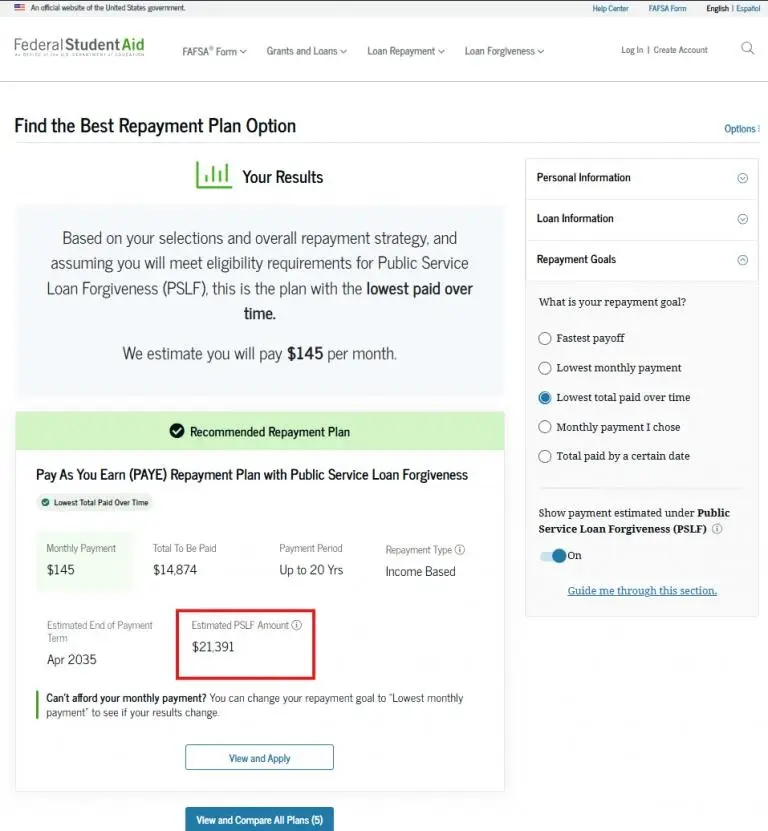
IBR and Public Service Loan Forgiveness
Another important consideration is Public Service Loan Forgiveness (PSLF).
Federal Student Aid explains that IDR plans can be relevant to borrowers pursuing PSLF, because qualifying borrowers may receive credit toward PSLF while making qualifying payments under an eligible repayment plan. (Student Aid)
This means a borrower working for a qualifying public-service employer should not evaluate an income-driven repayment plan solely by comparing the monthly payment.
Employment type, qualifying payments, eligible loans, and PSLF requirements can all affect the overall repayment strategy.
For official information, borrowers should review the current PSLF requirements on StudentAid.gov.
Important Limitations of an Income-Based Repayment Calculator
A calculator is powerful for estimation, but it cannot replace your official federal loan account.
The result can differ from your actual payment if:
- Your loan is not eligible for IBR.
- You enter an incorrect AGI.
- Your family size is entered incorrectly.
- Your loan balance has changed.
- Your loan has multiple interest rates.
- Your loan has an unusual status.
- Federal rules change.
- Your borrower status affects the applicable IBR percentage.
- Your calculated payment is subject to the Standard Repayment Plan cap.
- Your loan type has different eligibility requirements.
Federal Student Aid's current IBR guidance states that eligible loans generally include qualifying Direct Loans and certain FFEL Program loans, while loans made to parents, including Parent PLUS loans, are subject to specific restrictions. (Student Aid)
Therefore, the calculator should be used to understand and plan, while StudentAid.gov and your loan servicer should be used to confirm your official repayment information.
A Practical Way to Use the Calculator for Financial Planning
A useful approach is to create three scenarios.
Conservative Scenario
Use a lower income estimate that reflects a period of reduced earnings.
For example:
AGI = $45,000
This can help you understand whether your budget could handle the estimated payment during a difficult year.
Current Scenario
Use your latest available AGI.
For example:
AGI = $60,000
This gives you a baseline for current planning.
Higher-Income Scenario
Use a reasonable future income level.
For example:
AGI = $80,000
This can show how the estimated payment might change if your earnings increase.
The goal is not to predict the future perfectly. The goal is to understand the range of possible payment outcomes.
Comparing Income-Based Repayment With Other Repayment Approaches
An Income-Based Repayment calculation becomes more useful when you understand what it does and what it does not do. A monthly payment estimate should be considered alongside the loan balance, interest rate, repayment period, eligibility requirements, and your long-term financial plans.
Federal Student Aid currently lists several repayment options, and the rules applying to each borrower can depend on when the loans were first disbursed, the type of federal loans involved, and other eligibility requirements. The federal government also changed the repayment landscape through legislation enacted in 2025, making it especially important to use current information rather than relying on older student-loan articles. (studentaid.gov)
IBR Versus a Standard Fixed Payment
Under a traditional Standard Repayment Plan, the payment is generally structured around paying the eligible federal student-loan balance over a defined repayment period.
IBR works differently because the payment is tied to discretionary income and applicable borrower circumstances.
This creates a fundamental difference:
| Feature | Income-Based Repayment | Standard Repayment |
|---|---|---|
| Main payment factor | Income and family circumstances | Loan balance and repayment terms |
| Income changes can affect payment | Yes | Generally no |
| Family size can affect calculation | Yes | Generally no |
| Payment may be lower during lower-income periods | Potentially | Generally not because of income |
| Long-term interest consideration | Important | Important |
| Forgiveness provisions | May apply if requirements are met | Generally different |
Neither calculation should be considered in isolation. A borrower should look at both monthly affordability and long-term repayment consequences.
IBR Versus Other Income-Driven Options
IBR is only one part of the federal income-driven repayment landscape.
Federal Student Aid currently explains that eligibility for different repayment plans can depend on factors such as loan type and when the loans were taken out. Its current repayment-plan information also describes changes involving the availability of IBR, ICR, PAYE, and the newer Repayment Assistance Plan. (studentaid.gov)
For that reason, borrowers should not assume that an older article describing PAYE or another IDR plan still reflects their current options.
A calculator can help with the mathematical side of the decision. Your federal loan account and current StudentAid.gov guidance should be used for the eligibility side.
How Changes in Income Can Affect Your Payment
Income-based repayment is closely connected to your financial situation.
Suppose a borrower has:
- AGI: $55,000
- Family size: 2
- 2026 150% poverty guideline: $32,460
- Applicable IBR percentage: 10%
The simplified discretionary income is:
$55,000 − $32,460 = $22,540
Annual payment:
$22,540 × 10% = $2,254
Monthly payment:
$2,254 ÷ 12 = $187.83
Now suppose the borrower's AGI increases to $70,000.
$70,000 − $32,460 = $37,540
Annual payment:
$37,540 × 10% = $3,754
Monthly payment:
$3,754 ÷ 12 = $312.83
The simplified estimate rises by approximately $125 per month.
This is why borrowers should consider future income rather than looking only at their current paycheck.
A person entering a profession with rapid salary growth may want to model several income levels. Someone experiencing unstable income may want to examine lower-income scenarios as well.
What Happens When Your Family Size Changes?
Family size is another important variable.
Consider a borrower with an AGI of $70,000.
Using the 2026 guidelines for the 48 contiguous states and Washington, D.C.:
- Family size 1: 150% guideline = $23,940
- Family size 2: 150% guideline = $32,460
- Family size 3: 150% guideline = $40,980
- Family size 4: 150% guideline = $49,500
At a simplified 10% IBR rate, the resulting monthly calculations would be:
| Family Size | AGI | 150% Poverty Guideline | Discretionary Income | Annual at 10% | Monthly Estimate |
|---|---|---|---|---|---|
| 1 | $70,000 | $23,940 | $46,060 | $4,606 | $384 |
| 2 | $70,000 | $32,460 | $37,540 | $3,754 | $313 |
| 3 | $70,000 | $40,980 | $29,020 | $2,902 | $242 |
| 4 | $70,000 | $49,500 | $20,500 | $2,050 | $171 |
These are illustrative calculations, not official payment quotes.
The table demonstrates why family size is an important input when using the calculator.
What If Your Income Falls?
One of the important characteristics of an income-based system is that the calculation can respond to changes in income.
Suppose a borrower earned $75,000 last year but is now earning $50,000 because of a career transition.
Using the simplified two-person calculation:
$50,000 − $32,460 = $17,540
At 10%:
$17,540 × 10% = $1,754
Monthly:
$1,754 ÷ 12 = $146.17
This is substantially different from what the same borrower would calculate at a $75,000 AGI.
However, borrowers should not assume that simply experiencing a lower salary automatically changes their official payment immediately. The timing of income documentation, annual recertification, and federal servicing rules matters.
Federal Student Aid provides guidance on when borrowers can provide updated information and how annual recertification works. (studentaid.gov)
How Interest Affects the Bigger Picture
A monthly payment is only one part of student-loan planning.
Interest is another.
For example, assume a borrower has a $50,000 balance at 6% annual interest.
A simplified annual interest calculation is:
$50,000 × 6% = $3,000
Approximate monthly interest:
$3,000 ÷ 12 = $250
If the required payment were $150 in a simplified illustration, the payment would be lower than that simple monthly interest amount.
This does not by itself determine what happens to the loan under the federal rules, because federal interest treatment can depend on the loan and repayment circumstances. But it demonstrates why borrowers should not assume that making a required payment automatically means the principal balance is falling quickly.
Federal Student Aid explains that interest accrues on federal student loans and that capitalization can increase the principal balance under applicable circumstances. (studentaid.gov)
That is why an income-based repayment calculator is most useful when paired with a broader understanding of payment, interest, balance, and repayment period.
Common Mistakes When Calculating an IBR Payment
Even a straightforward calculation can produce the wrong result when incorrect information is entered.
Mistake 1: Using Gross Salary Instead of the Requested Income Figure
A salary of $70,000 is not necessarily the same as an AGI of $70,000.
Always check the calculator's instructions and use the requested income measure.
Mistake 2: Forgetting Family Size
Family size directly affects the applicable poverty guideline.
Leaving family size at one when your applicable family size is larger can produce a different discretionary-income calculation.
Mistake 3: Using an Outdated Poverty Guideline
Federal poverty guidelines are updated periodically.
For a current calculation, use the appropriate year's guideline. HHS publishes the official poverty-guideline tables. (aspe.hhs.gov)
Mistake 4: Assuming Every Borrower Uses the Same Percentage
Current Federal Student Aid guidance distinguishes between borrowers subject to the 10% and 15% IBR percentages. (studentaid.gov)
Do not automatically apply 10% to every borrower.
Mistake 5: Ignoring Loan Eligibility
Not every student loan qualifies for every repayment plan.
Federal Student Aid provides specific eligibility rules for IBR and restrictions involving certain loans, including Parent PLUS loans. (studentaid.gov)
Mistake 6: Treating the Calculator Result as an Official Quote
The calculator provides an estimate based on the information entered.
Your actual payment can differ based on your federal loan account and the rules applicable to your loans.
Mistake 7: Looking Only at the Monthly Payment
A lower monthly payment can improve cash flow, but you should also consider interest, repayment duration, forgiveness requirements, and future income.
How to Get More Accurate Calculator Results
Before using the iCreditCalculators calculator, gather the information you can verify from your financial records.
A useful checklist is:
- Current federal student-loan balance
- Current interest rate or rates
- Latest AGI
- Correct family size
- State of residence
- Loan type
- Date the loans were first disbursed
- Current repayment status
- Applicable repayment-plan information
- Current federal recertification information
The more accurate your inputs are, the more useful the resulting estimate will be.
For official loan information, borrowers can sign in to StudentAid.gov and review their federal loan portfolio and repayment information.
A Simple IBR Planning Worksheet
You can use the following structure before entering your information into the calculator:
| Input | Your Information |
|---|---|
| Federal student-loan balance | $________ |
| Interest rate | ________% |
| Adjusted gross income | $________ |
| Family size | ________ |
| State | __________ |
| Applicable IBR percentage | ________% |
| 150% poverty-guideline amount | $________ |
| Estimated discretionary income | $________ |
| Estimated annual payment | $________ |
| Estimated monthly payment | $________ |
This worksheet makes it easier to identify missing information before calculating.
It also creates a useful record that you can compare with future estimates after your income or family circumstances change.
When Should You Recalculate?
There are several situations when running the calculator again can be useful.
After a Significant Income Change
A promotion, job change, reduction in hours, career transition, or other major income change can affect your income-based calculation.
After a Family-Size Change
Marriage, divorce, birth, adoption, or another change that affects applicable family-size information can make a new calculation worthwhile.
Before Annual Recertification
Running an estimate before recertification can help you understand what your next payment might look like.
Federal Student Aid emphasizes the importance of annual recertification for IDR borrowers. (studentaid.gov)
When Federal Rules Change
Student-loan repayment rules can change through legislation, regulations, or federal guidance.
The 2026 repayment environment demonstrates why borrowers should check current federal information instead of relying on a calculator result created under an older set of rules.
Using the Calculator for Budget Planning
The calculator can also be used as part of a broader monthly budget.
Suppose your estimated payment is $250 per month.
That is:
$250 × 12 = $3,000 per year
You can then include that amount alongside:
- Housing
- Utilities
- Food
- Transportation
- Insurance
- Retirement contributions
- Emergency savings
- Credit-card payments
- Other loan payments
- Investment contributions
This gives you a more complete picture of your financial obligations.
For a borrower with irregular income, it can also be useful to build a budget using a higher estimated payment rather than assuming today's payment will remain unchanged indefinitely.
Income-Based Repayment and Financial Goals
Student-loan repayment should be considered alongside other financial priorities.
For example, a borrower may need to decide how to balance student-loan payments with:
- Building an emergency fund
- Paying high-interest credit-card debt
- Saving for retirement
- Buying a home
- Starting a business
- Supporting dependents
- Building cash reserves
The calculator does not make these decisions for you.
Instead, it provides one important piece of information: an estimate of the student-loan payment associated with the inputs you provide.
That information can then be included in your larger financial plan.
A Quick Checklist Before You Trust Your Result
Before relying on an estimate, check the following:
- Is the loan eligible for IBR?
- Did you enter the correct AGI?
- Did you enter the correct family size?
- Did you use the appropriate poverty guideline?
- Did you select the correct state?
- Did you identify whether the 10% or 15% IBR rate applies?
- Did you enter the current loan balance?
- Did you enter the correct interest rate?
- Did you check the current federal repayment rules?
- Did you compare the result with your official StudentAid.gov information?
If any of these inputs are uncertain, treat the calculator output as a preliminary estimate.
Key Takeaways
The most important points to remember are:
- IBR connects repayment to income and family circumstances.
- AGI is an important input, but it should not automatically be treated as discretionary income.
- The traditional calculation first subtracts the applicable protected amount based on 150% of the federal poverty guideline.
- The applicable IBR percentage can be 10% or 15%, depending on the borrower's status and current federal rules.
- Family size matters because it changes the applicable poverty-guideline amount.
- State matters because Alaska and Hawaii use different poverty guidelines.
- A calculator can make the arithmetic easier, but it does not determine official eligibility.
- Your payment can change when your income or family circumstances change.
- Annual income and family-size recertification can be an important part of staying on an income-driven plan.
- A lower monthly payment does not necessarily mean a lower total cost of borrowing.
- Interest and loan balance should be considered alongside payment affordability.
- Borrowers pursuing PSLF or other forgiveness programs should separately verify the applicable requirements.
- Current federal rules should always be checked because student-loan repayment programs can change.
Frequently Asked Questions
What is an Income-Based Repayment Calculator?
An Income-Based Repayment Calculator estimates a potential student-loan payment using income, family size, poverty-guideline information, and the applicable IBR percentage. It is designed to simplify the underlying calculation and help borrowers understand potential monthly payment amounts.
What information do I need to use the calculator?
You generally need your adjusted gross income, family size, state, student-loan balance, and interest rate. You should also understand your loan type and whether you meet the applicable IBR requirements.
How is discretionary income calculated for IBR?
Under the traditional IBR calculation described by Federal Student Aid, discretionary income is generally calculated by subtracting 150% of the applicable federal poverty guideline from AGI. (studentaid.gov)
Is IBR always 10% of discretionary income?
No. Current Federal Student Aid information states that IBR uses 10% for qualifying new borrowers and 15% for borrowers who are not new borrowers, subject to the applicable federal rules. (studentaid.gov)
Does family size affect an IBR payment?
Yes. Family size affects the poverty-guideline amount used to calculate discretionary income. A larger applicable family size can therefore change the calculation.
Can an IBR payment be $0?
A simplified calculation can produce no positive payment when the applicable income amount does not exceed the protected amount. However, borrowers should rely on the official federal determination for their actual payment and eligibility.
Does student-loan interest still matter under IBR?
Yes. The monthly payment calculation and the interest accruing on the loan are separate concepts. Understanding both is important when evaluating the long-term effect of repayment.
Can my IBR payment increase if my income increases?
Yes. Because the calculation is tied to income, an increase in the income information used for the calculation can increase the resulting payment.
How often do I need to update my income?
Federal Student Aid generally requires IDR borrowers to recertify income and family size annually. (studentaid.gov)
Is the calculator's result my official student-loan payment?
No. The calculator is a planning estimate. Your loan servicer and Federal Student Aid determine the official payment under the federal rules applicable to your loans.
Can I use the calculator if I have multiple federal loans?
You can use an estimate for planning, but multiple loans can have different characteristics, including different interest rates and eligibility considerations. Review your federal loan portfolio carefully before making repayment decisions.
Does IBR qualify for student-loan forgiveness?
IBR can provide forgiveness after the applicable repayment period if the borrower meets the relevant requirements. Current Federal Student Aid information describes 20-year and 25-year IBR forgiveness periods, depending on the borrower's applicable status. (studentaid.gov)
Can IBR payments count toward PSLF?
Qualifying payments made under an eligible income-driven repayment plan can potentially count toward PSLF when the borrower meets all applicable PSLF requirements. Borrowers should verify their specific status through StudentAid.gov. (studentaid.gov)
Final Thoughts
An Income-Based Repayment Calculator from iCreditCalculators can make a complicated student-loan calculation much easier to understand. Instead of focusing only on the amount originally borrowed, the calculation considers the relationship between income, family size, poverty-guideline protection, and the applicable repayment percentage.
The most useful way to use the calculator is not simply to ask, “What is my payment today?” Instead, use it to explore several realistic situations. Test your current income, a lower-income scenario, and a higher-income scenario. If your family circumstances change, run the calculation again.
At the same time, remember that an online calculator is a planning tool, not an official federal determination. Federal Student Aid's current repayment rules, your loan type, your borrower history, your income documentation, and your individual loan account all matter.
For the most reliable planning process, start with accurate information from your federal student-loan account, use the iCreditCalculators Income-Driven Repayment Calculator to model potential outcomes, and then verify your actual repayment options through StudentAid.gov.
A good calculator does more than produce a number. It helps you understand why that number changes, what information drives it, and which financial questions you should ask before committing to a repayment strategy. For borrowers managing substantial student debt, that understanding can make repayment planning clearer and more practical.
Sachin Ramdurg
Founder & Software Engineer
Sachin Ramdurg is the creator of iCreditCalculators.com. He brings over 15 years of software engineering expertise to build precision-engineered, privacy-first financial tools that empower consumers.